
Epoxy Coating vs Epoxy Flooring: What Is the Difference
Epoxy Coating vs Epoxy Flooring: What Is the Difference?
When you walk into a factory, a showroom or a hospital basement, you will often see a smooth and glossy floor. If you ask three people what it is, you will probably get three different answers, such as epoxy coating, epoxy flooring or simply floor paint.
These terms do not mean the same thing, and confusing them can get expensive. A thin coating on a floor that carries forklifts will crack and peel within a year. A thick system in a quiet storeroom, on the other hand, costs more than the space needs.
This guide explains the difference between epoxy coating and epoxy flooring in simple words. It also covers polyurethane, since most buyers ask about it sooner or later. If you are wondering what is pu flooring and whether it beats epoxy, you will find the answer below. If you are comparing epoxy flooring vs polyurethane flooring for a project, the head-to-head section will help you decide.
The Short Answer
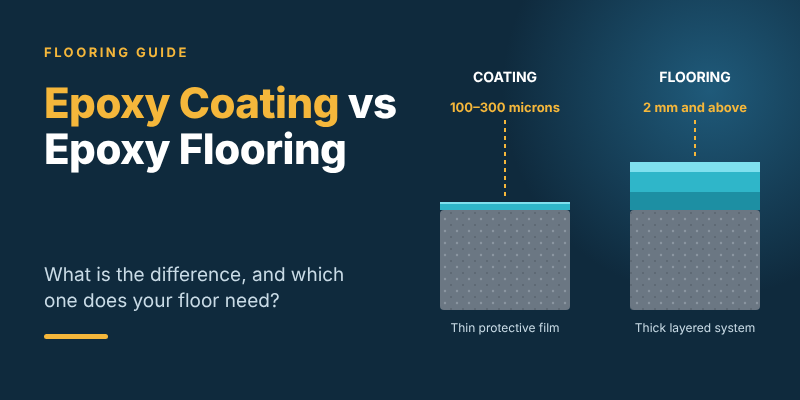
Epoxy coating is a thin film, usually 100 to 300 microns thick, which is rolled or sprayed over prepared concrete. Epoxy flooring is a thick, layered system, usually 2 mm or more, which is built from a primer, a resin body and often quartz or aggregate. A coating protects and brightens the floor, while a flooring system carries the load.
What Is Epoxy Coating?
Epoxy coating is a thin protective layer of two-part resin applied over concrete. The installer first grinds the slab and fills the cracks. Then they roll on a primer and apply one or two coats of colour. Most floors can take foot traffic the next day.
This option works well for light to moderate traffic, such as parking bays, garages, retail floors, godowns that use hand trolleys and utility rooms. It controls dust and resists oil and water.
The main limit is thickness. A coating follows every bump and pit in the concrete below it, and it wears faster under steel wheels or dragged pallets. If the slab is rough, the coating will show every flaw.
What Is Epoxy Flooring?
Epoxy flooring is a built-up system that works like a new floor surface on top of the concrete. Depending on the specification, it can be a self-levelling layer of 2 to 4 mm, or a heavy mortar system that is even thicker.
Because it has real body, it hides small surface flaws, handles forklifts and heavy racking, and survives chemical spills far better than a thin coating. This is why pharmaceutical units, food plants, workshops and manufacturing halls choose it. A well-laid system can last ten years or more.
The trade-off is that it costs more and takes longer to install and cure.
What Is PU Flooring?
Polyurethane, or PU, flooring uses a resin that stays slightly flexible after it cures. Epoxy becomes hard and rigid, while PU can flex a little. This small difference matters in places with big temperature swings, such as commercial kitchens, cold rooms and dairy plants, where a hot washdown and freezing air can hit the same floor during one shift.
PU also holds its colour in sunlight and resists scuffs well. It is often used as a topcoat, and in thicker forms as PU concrete for demanding food and beverage areas. This is the core of the epoxy flooring vs polyurethane flooring debate, because epoxy offers rigid strength while PU offers flexible toughness.
Epoxy Flooring vs Polyurethane Flooring: Head-to-Head
The points below show how the two systems compare on the factors that matter most to buyers.
- Epoxy is harder and bonds strongly to concrete, so it performs better under heavy static and rolling loads.
- PU is more flexible, so it copes better with thermal shock and small slab movement.
- Epoxy can yellow or chalk under direct sunlight, while PU stays stable.
- PU resists scratches and scuffing better than epoxy.
- PU is less forgiving on damp slabs, since moisture during installation can cause bubbles.
- PU usually costs more per square foot.
Neither system is better in every case. In a dry indoor warehouse, epoxy normally does the job well. In a hot, wet kitchen or a sunny loading dock, PU is worth the higher price.
When a Hybrid Makes Sense
Many projects use both materials together. This approach is called pu epoxy flooring, and it combines an epoxy primer and body coat for strength with a PU topcoat for UV stability and wear resistance. Car showrooms, semi-outdoor docks and busy corridors often use this build-up. It gives you the strong bond of epoxy and the tougher surface of PU in a single floor.
Polyurethane vs Epoxy Floor Coating: How to Choose
Polyurethane vs epoxy floor coating does not have one universal answer, because the right choice depends on the space. The following guide can help you decide.
- For forklifts or heavy machinery indoors, choose epoxy flooring.
- For light traffic and a tight budget, choose epoxy coating.
- For sunlight, heat or hot washdowns, choose PU or pu epoxy flooring.
- For food, dairy or cold storage areas, choose PU.
- For an uneven or worn slab, choose a thicker system.
- For a damp slab, fix the moisture problem first, whichever system you choose.
Mistakes That Ruin Good Floors
Most floor failures have little to do with the resin itself, since the problems usually start underneath it. Common causes include skipped moisture testing, which lets vapour push blisters through the film, and poor grinding, which leaves a weak surface that the resin cannot grip. Other causes are the wrong thickness for the load and a rushed cure.
Before work begins, make sure the slab is at least 28 days old, get a moisture reading in writing and ask for the material data sheets.
Choosing PU Flooring Services
Whether you need epoxy, PU or both, you should judge the contractor before the product. Good pu flooring services begin with a site visit, a slab moisture test and a written scope that states the thickness, material brand and cure schedule. You should also ask to see finished work at a similar site and find out exactly what the warranty covers.
Be careful with any quote that gives one rate per square foot without a specification. Honest pu flooring services will also tell you when plain epoxy is enough and PU would be a waste of money.
Final Thoughts
Epoxy coating is a thin layer for light-duty areas, while epoxy flooring is a thick system for tough environments. PU adds flexibility and UV stability where epoxy struggles. The polyurethane vs epoxy floor coating decision comes down to traffic, temperature and sunlight. If you are still weighing epoxy flooring vs polyurethane flooring for a specific site, get it inspected before you buy any material.
FAQs
1. Is epoxy coating the same as epoxy flooring?
No, they are different. Epoxy coating is a thin film, typically 100 to 300 microns, meant for light-duty protection. Epoxy flooring is a thick, multi-layer system of 2 mm or more, meant for heavy use. Both come from the same resin family, but they differ in thickness, strength and lifespan.
2. Which is better, epoxy or polyurethane?
Neither one wins in every situation. In the epoxy flooring vs polyurethane flooring question, epoxy is the stronger choice for heavy loads on dry indoor floors, while PU is better for heat, thermal shock and sunlight.
3. Can PU be applied over epoxy?
Yes, it can. A PU topcoat over a cured epoxy base is common, as long as the epoxy is recoated or lightly abraded within the manufacturer’s recoat window. This is how pu epoxy flooring systems are built.
4. How long does an epoxy floor take to cure?
Most floors take foot traffic after about 24 hours and light vehicles after two to three days. Full chemical cure takes around seven days, and thicker systems need more time. You should always follow the product data sheet.
5. What is PU flooring best suited for?
It is best suited for food and beverage plants, cold rooms, commercial kitchens, breweries and semi-outdoor areas, where heat, moisture swings or sunlight can damage a rigid epoxy surface.